What Are Banchan? Korean Side Dishes Explained
Banchan are the small side dishes served with rice at a Korean meal: what they are, the common kinds, whether refills are free, and how to eat them.
Published
Order one dish at a Korean restaurant, and several small plates may land on the table before or with it: kimchi, seasoned greens, maybe something braised or pan-fried. Those are banchan (반찬), Korean side dishes.
The short version:
- Banchan are the side dishes eaten with rice. At home and in restaurants, a Korean meal is often rice, soup or stew, and several banchan.
- They’re often shared. At many restaurants, the small plates go in the middle of the table for everyone.
- In Korea, they usually come with the meal at no extra charge, and you can usually ask for more. There are exceptions, and in the US, policies vary by restaurant.
- Eat them with your rice and main dish, in any order you like. You don’t have to finish every plate.
What banchan means
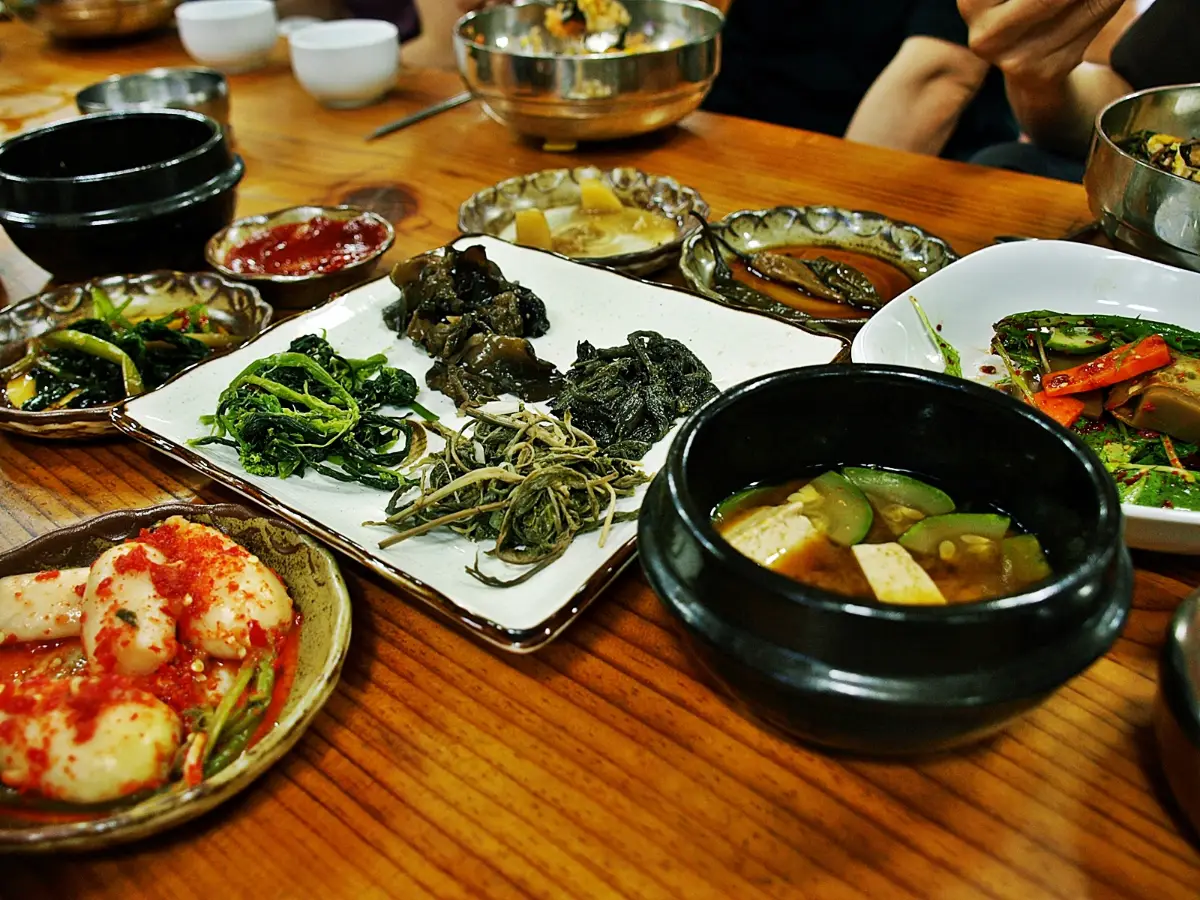

The Standard Korean Dictionary, published by the National Institute of Korean Language, defines banchan as a general term for the food eaten along with rice. The word isn’t only for restaurants. It’s the everyday word for side dishes at a family meal, too.
The Encyclopedia of Korean Culture describes the everyday Korean table this way: rice is the main food, the banchan are the accompaniments, and a soup or stew usually completes the meal. VisitKorea, the Korea Tourism Organization’s site, describes the same layout: each person’s rice and soup in front of them, with the side dishes arranged around them.
You may also hear mitbanchan (밑반찬), “basic side dishes.” These are side dishes made ahead of time and stored for later meals, so they can be served without reheating. Examples include jangjorim (beef simmered in soy sauce) and kongjaban (braised black soybeans). The Encyclopedia of Korean Culture treats mitbanchan as a separate group from kimchi.
Why so many small plates?
Plain rice doesn’t have much seasoning, so it’s eaten with dishes that do. In a 2023 Korea JoongAng Daily article, Cho Young-ha, a researcher at the Academy of Korean Studies, explained that Koreans tend to eat rice, side dishes, and soup together and think the combination tastes best.
VisitKorea puts it simply: how you eat the banchan is up to you. You decide what to pair with each bite of rice, and you can try two or three things at once.
Traditional Korean table settings even had a counting system. The Encyclopedia of Korean Culture describes settings classified by the number of side dishes, from 3-cheop up to 12-cheop, with conventions meant to avoid repeating ingredients and cooking methods. The rice and soup weren’t part of the count. These are traditional table-setting conventions, not rules that today’s homes or restaurants follow.
Common kinds of banchan
Many banchan are named for how they’re made. These are some of the kinds you’re likely to see.
| Kind | Korean | What it is |
|---|---|---|
| Kimchi | 김치 | Salted, seasoned vegetables, usually fermented. Often spicy, but not always. |
| Namul | 나물 | Vegetables, greens, or mushrooms, blanched and dressed or stir-fried. Seasonings may include soy sauce or salt, sesame oil, garlic, and green onion. Common examples include spinach and soybean sprouts. |
| Bokkeum | 볶음 | Stir-fried dishes, such as small dried anchovies (myeolchi bokkeum) or shredded dried squid. |
| Jorim | 조림 | Ingredients simmered in a seasoned sauce, such as jangjorim or braised lotus root. |
| Jeon | 전 | Pan-fried slices or small pancakes, often coated in flour and egg. |
| Jangajji | 장아찌 | Vegetables pickled in a seasoned liquid such as soy sauce. |
| Jeotgal | 젓갈 | Salted, fermented seafood. Very salty, eaten in small amounts. |
What shows up depends on the restaurant, the meal, and the season. Even a simple order can come with banchan: Korea JoongAng Daily notes that a bowl of ramyeon often arrives with just kimchi and pickled radish. If you’re new to kimchi, our guide to choosing kimchi at a Korean grocery store explains the main types.
Are banchan free? Can you ask for more?
In Korea: usually, yes. VisitKorea tells visitors that asking for extra water or side dishes doesn’t cost extra, and that more restaurants now let you refill water and side dishes yourself at a self-service station. Korea JoongAng Daily describes free refills as the norm, with exceptions: some restaurants charge for extra lettuce and other leaves for wrapping grilled meat, and some refill pricier side dishes only once, or not at all.
Free banchan also matter to Korean diners. In a February 2026 survey of 1,000 Korean adults aged 19 to 69 by the market research firm Embrain Trend Monitor, reported by Herald Kyungje, 63.9% agreed that free side dishes are a special part of Korean restaurant culture.
In the US: there’s no single rule. Selection, refills, and charges depend on the restaurant, so if you’re not sure, ask your server whether banchan come with your meal and whether refills are included.
Asking politely: point to the empty plate and ask your server. In Korea, staff usually understand “Yeogiyo!” (여기요, “Excuse me!”) to get their attention, as VisitKorea notes.
How to eat banchan
- They’re not a separate course. If banchan arrive before your main dish, you can start eating them.
- Eat them with rice and your main dish, a bite at a time, in whatever combination you like.
- Shared plates are for everyone. Take a small amount at a time rather than pulling a whole plate toward you.
- You don’t have to eat everything. Try what looks good. If you finish one you like, it’s fine to ask for more instead of taking a big pile at once.
- Salty dishes go a long way. Jeotgal and some pickles are meant to be eaten a little at a time with rice.
Spicy food, vegetarian diets, and allergies
Banchan can look simple, but you can’t always tell what’s in them by looking.
- Spice: many kimchi and some other banchan use chili. Namul, jorim, and jeon are often mild, but not always.
- Hidden animal products: many kimchi contain fish sauce or salted shrimp. A vegetable dish isn’t necessarily vegetarian.
- Common allergens: soy sauce is often made with wheat, and sesame oil and sesame seeds are common. Fish, crustacean shellfish, soy, wheat, eggs, and sesame are among the nine major food allergens the FDA identifies.
- Restaurant food usually has no label. Unlike packaged food, banchan served at a restaurant generally don’t come with an ingredient list. If you have a food allergy, tell your server before you eat and ask about ingredients and possible cross-contact. If the restaurant can’t confirm a dish is safe for you, skip it.
Frequently asked questions
Do all Korean restaurants serve banchan? Not necessarily. The number and kind depend on the restaurant and what you order. Some meals come with just one or two.
Do banchan come with Korean barbecue? Often, yes, along with leaves for wrapping the meat. What’s included, and whether extras cost more, depends on the restaurant.
Is it rude to leave banchan uneaten? No. You don’t have to eat every side dish. To avoid waste, ask for refills only of the ones you’ll eat.
Sources
- National Institute of Korean Language, Standard Korean Dictionary: 반찬 (Korean) (checked November 8, 2026)
- Encyclopedia of Korean Culture (Academy of Korean Studies): 반상 (Korean) (checked November 8, 2026)
- Encyclopedia of Korean Culture (Academy of Korean Studies): 밑반찬 (Korean) (checked November 8, 2026)
- Encyclopedia of Korean Culture (Academy of Korean Studies): 나물 (Korean) (checked November 8, 2026)
- Encyclopedia of Korean Culture (Academy of Korean Studies): 볶음 (Korean) (checked November 8, 2026)
- VisitKorea (Korea Tourism Organization): About Korean Food (checked November 8, 2026)
- Korea JoongAng Daily: [WHY] Why do Korean restaurants serve so many side dishes? (May 6, 2023) (checked November 8, 2026)
- Herald Kyungje (US edition): Embrain Trend Monitor survey on side-dish refills (Korean, Mar. 24, 2026) (checked November 8, 2026)
- US Food and Drug Administration: Food Allergies, What You Need to Know (checked November 8, 2026)
Spotted an error? Tell us and we will correct it. See how we write.