What Is Kimjang? Korea's Fall Tradition of Making and Sharing Kimchi
Kimjang is Korea's late-fall custom of making a winter's supply of kimchi together and sharing it: when it happens, why people help, and how it's changing.
Published
Each late fall, many Korean families set aside time to make kimchi. Not a jar or two, but enough to last through winter. That custom is called kimjang (김장, gimjang in the official romanization).
The short version:
- Kimchi is the food. Kimjang is the event: making a large batch of kimchi in late fall, usually with family or neighbors, and sharing it.
- When: traditionally around early November. Today, kimjang commonly takes place between mid-November and early December.
- Why together: salting and seasoning dozens of cabbages is a lot of work, so people help each other and split the results.
- It’s changing: households make smaller batches, many buy cabbage already salted, and many people buy kimchi instead.
- Recognized by UNESCO: in 2013, as “Kimjang, making and sharing kimchi in the Republic of Korea.” It’s the custom that is listed, not kimchi as a dish.
- Not a holiday: there’s no day off. Families pick their own day.
What kimjang is
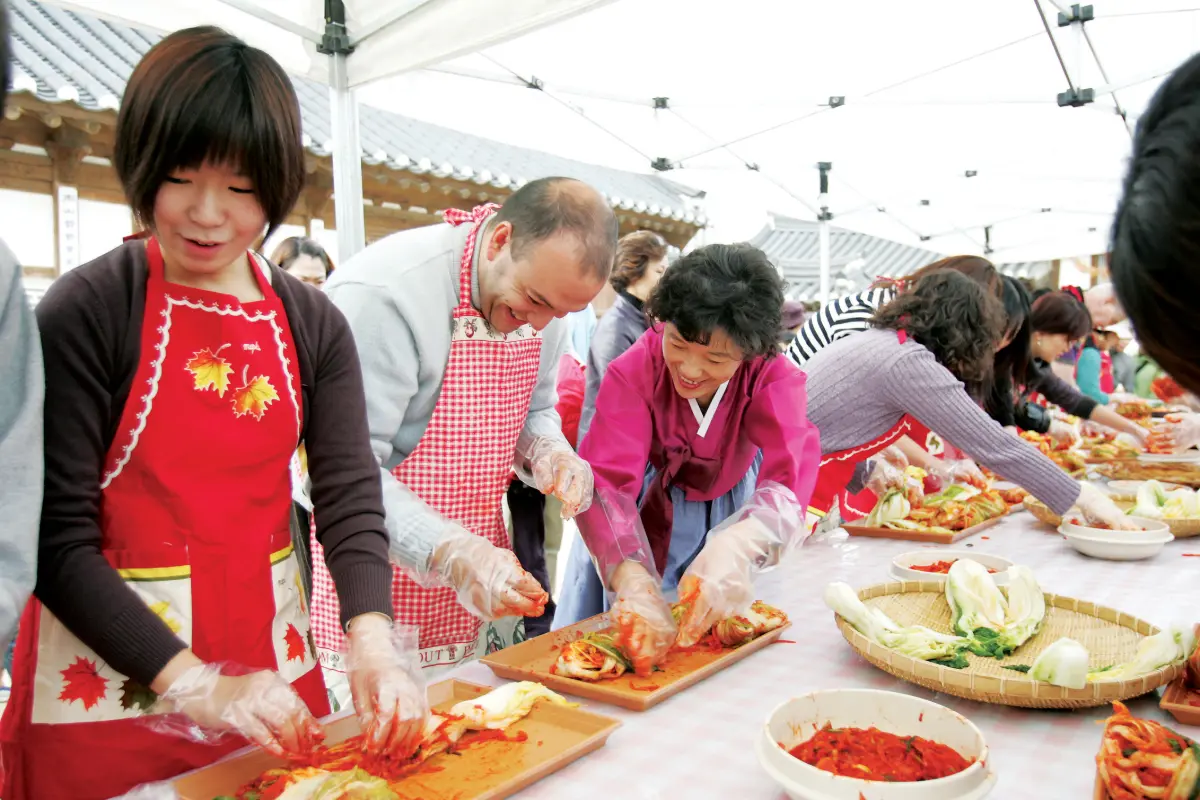

Kimchi covers a wide variety of seasoned vegetable dishes, most of them salted and fermented. (If you’re new to it, our guide to choosing kimchi at a Korean grocery store covers the main types.) Kimjang uses the fall harvest of napa cabbage and Korean radish. Before refrigerators and year-round produce, one large batch made in late fall gave a household kimchi to eat from winter into spring.
In UNESCO’s description of the tradition, kimjang is the end of a year-long cycle of preparation. Not every household follows these steps today, but they show how much planning went into it:
- Spring: buy shrimp, anchovies, and other seafood to salt and ferment.
- Summer: buy sea salt for the brine.
- Late summer: dry red chilies and grind them into powder.
- Late fall: make the kimchi, in large batches.
The day itself has two big jobs. First, the cabbages are split and salted so they soften. Then they’re rinsed, drained, and coated leaf by leaf with a seasoning paste, typically chili powder, garlic, ginger, green onion, and salted seafood. Recipes differ by region and by family. Traditionally, each family passed down its own methods, and UNESCO notes that households treat them as family heritage.
When it happens
Traditionally, kimjang is timed around Ipdong (입동), “the start of winter,” one of the 24 seasonal markers of the old East Asian calendar. It falls around November 8. The Encyclopedia of Korean Culture says kimjang tastes best when done just before or just after Ipdong: much later, the vegetables are no longer fresh and the ground freezes, which made the work harder.
In practice, there’s no fixed date, and today it usually comes a little later. In a 2025 survey of 1,000 households by the Korea Rural Economic Institute (KREI), 73.1% planned to make their kimchi between mid-November and early December. According to UNESCO, households check the weather forecast to pick the best day and temperature.
Why people do it together
Kimjang used to be a large job. Korea.net described how, traditionally, a household might prepare several hundred cabbages and store the kimchi in earthenware jars buried in the ground to keep it cold through winter.
That much work was easier with help. According to the Encyclopedia of Korean Culture:
- Relatives and neighbors took turns helping each other with their kimjang.
- The host family fed the helpers, with dishes such as cabbage soup and boiled pork.
- Families shared salted cabbage, seasoning, and freshly made kimchi with neighbors afterward.
The sharing part is what UNESCO emphasized when it listed kimjang: it said the custom strengthens cooperation within families and solidarity among neighbors.
Today, the sharing often takes the form of charity kimjang. In November 2024, for example, the Seoul chapter of the Korean Red Cross ran a kimjang campaign with about 800 volunteers. It planned to make more than 60 tons of kimchi for 6,372 households in need across Seoul, according to The Asia Business Daily. Local governments and companies hold similar sharing events in the fall.
How kimjang is changing
Kimjang hasn’t disappeared, but it has shrunk and gotten easier.
- Smaller batches. In KREI’s 2025 survey, a four-person household planned to buy 18.3 heads of cabbage for kimjang, below KREI’s average for recent years of 21.2 heads. (These are survey answers about plans, not sales data.)
- Pre-salted cabbage. Salting is the hardest and slowest step, so many people buy cabbage that’s already salted and drained (절임배추, jeorim baechu). In KREI’s 2025 survey, pre-salted cabbage was the most common choice for kimjang, at 58.9% of planned cabbage purchases. Korea.net noted that this cuts the work from two or three days to about one.
- Kimchi refrigerators. Instead of jars in the ground, many homes now store kimchi in a kimchi refrigerator (김치냉장고, kimchi naengjanggo), an appliance with settings designed for storing and fermenting kimchi.
- Buying instead of making. Many households buy kimchi or get it from parents and relatives instead of making their own. In KREI’s 2025 survey, 62.3% of households said they would make their own kimchi and 32.5% planned to buy it, up from 29.5% the year before.
What UNESCO and Korea recognize
- UNESCO, 2013: “Kimjang, making and sharing kimchi in the Republic of Korea” was inscribed on the Representative List of the Intangible Cultural Heritage of Humanity. The listing is about the practice and the sharing, not about kimchi as a food.
- UNESCO, 2015: North Korea’s “Tradition of kimchi-making in the Democratic People’s Republic of Korea” was inscribed separately.
- South Korea, 2017: the government designated kimchi-making (김치 담그기, kimchi damgeugi) as a national intangible heritage. This covers making kimchi in general, not only the big fall batch. No individual master or group was named as its holder, because, as the Encyclopedia of Korean Culture explains, it’s a custom practiced across the country rather than a specialist skill.
- Kimchi Day (November 22): South Korea made it an official commemorative day in 2020. It’s not a day off. Some US states have their own Kimchi Day designations; see our kimchi guide.
Kimjang in the US
Kimjang is mainly a custom in Korea, but you can see it in the US too.
- Korean Cultural Centers sometimes hold kimjang events. As a past example, in November 2025 the Korean Cultural Center Washington, D.C. held “Kimjang DC 2025,” a free event with a kimchi demonstration and a workshop where attendees made kimchi to take home. Check the official website of the Korean Cultural Center nearest you for upcoming events.
- Ask a Korean friend whether their family makes kimchi together. Practices vary a lot, in Korea and in the US, so don’t assume every Korean family does it.
- Or just buy a jar. A Korean grocery store is the easy way to taste what all the work is for.
If you make or buy a big batch, keep it in the fridge at 40°F (4°C) or below and use clean utensils. Our kimchi guide has the storage basics.
Frequently asked questions
Is kimjang a holiday in Korea? No. It’s a household event, not a public holiday. Each family picks its own day.
Do Koreans still do kimjang? Many do, but in smaller batches, and often with pre-salted cabbage. Many others buy kimchi or receive it from relatives.
What do people eat on kimjang day? The people who helped usually share a meal. Boiled pork with freshly made kimchi is a classic, and the Encyclopedia of Korean Culture also mentions cabbage soup. Korea.net mentions oysters. Menus vary by family.
Sources
- UNESCO Intangible Cultural Heritage: Kimjang, making and sharing kimchi in the Republic of Korea (inscribed 2013, 8.COM) (checked November 4, 2026)
- UNESCO Intangible Cultural Heritage: Decision 10.COM 10.B.14, Tradition of kimchi-making in the DPRK (2015) (checked November 4, 2026)
- Encyclopedia of Korean Culture (Academy of Korean Studies): 김치 담그기 (Korean) (checked November 4, 2026)
- Encyclopedia of Korean Culture (Academy of Korean Studies): 입동 (Korean) (checked November 4, 2026)
- Korea.net: Kimchi-making has become easier for all (Nov. 27, 2018) (checked November 4, 2026)
- Korea Rural Economic Institute (KREI): 2025 consumer kimjang intentions and vegetable supply outlook, Agricultural Policy Focus No. 231 (Korean, Nov. 7, 2025) (checked November 4, 2026)
- The Asia Business Daily: Korean Red Cross kimjang sharing event in Seoul (Nov. 19, 2024) (checked November 4, 2026)
- Herald Kyungje: Kimchi Day (Nov. 22), a statutory commemorative day since 2020 (Korean, Nov. 2025) (checked November 4, 2026)
- Korean Cultural Center Washington, D.C.: Kimjang DC 2025, Making & Sharing Kimchi (checked November 4, 2026)
Spotted an error? Tell us and we will correct it. See how we write.