Is Chuseok the Korean Thanksgiving? How the Two Holidays Compare
Chuseok is often called Korean Thanksgiving. Here's what the fall holiday actually is, how it compares with American Thanksgiving, and how it's changing.
Published
If you have Korean friends or coworkers, you may have heard Chuseok (추석) described as “Korean Thanksgiving.” The nickname is a useful starting point. Both are fall holidays built around family, food, and gratitude. But the similarities only go so far. Chuseok has its own history and calendar, and its own traditions, including honoring ancestors through memorial rites and grave visits.
The short version:
- What it is: Chuseok is one of South Korea’s biggest traditional holidays, held on the 15th day of the eighth month of the lunar calendar, under a full moon.
- When: it moves on the Western calendar, usually landing in September or early October. In 2026 it fell on Friday, September 25, with a three-day public holiday from September 24 to 26.
- Why the nickname: it marks the harvest, people travel home to their families, and there’s a holiday feast.
- The big difference: traditional Chuseok customs include charye, a memorial rite for ancestors, and visits to family graves, alongside the harvest and family gatherings. Thanksgiving centers on a shared meal. Not every Korean household keeps these customs today.
- Signature food: songpyeon, small half-moon rice cakes, rather than turkey and pie.
- It’s changing: in a 2026 survey, far fewer households said they planned to hold the ancestral rite than the year before, and many of those who did planned a simpler table.
Why people call it “Korean Thanksgiving”
The comparison is common enough that even the English pages of Korean institutions use it. The National Folk Museum of Korea, for example, refers to Chuseok as “Korean Thanksgiving Day.”
The two holidays do overlap. Chuseok comes at harvest time, and it has long been a time to give thanks for the year’s crops. Families gather, often after a long trip, and share a big holiday meal. For an American reader, “Thanksgiving” is a quick way to say “the big fall family holiday.”
Where the label misleads is in what the traditions focus on. Thanksgiving is organized around a meal. Traditional Chuseok customs also include a rite for ancestors at home and a visit to family graves, and the holiday food is part of that rite.
What is Chuseok?
Chuseok falls on the 15th day of the eighth lunar month. Because the lunar calendar doesn’t line up with the Western one, the date changes every year. According to the Korea AeroSpace Administration’s official 2027 calendar, Chuseok 2027 falls on Wednesday, September 15, with public holidays from September 14 to 16.
The holiday has several Korean names. Besides Chuseok, the most familiar is Hangawi (한가위). Older names include gabae and gawi. It is also called Jungchujeol, “mid-autumn festival.”
In Korean tradition, Chuseok is closely tied to the bright autumn full moon, a symbol of abundance, arriving when the summer’s crops are ripe. An old Korean saying captures the mood: deodo malgo deoldo malgo Hangawi-mankeumman, roughly “no more, no less, just like Hangawi,” a wish for every day to be as abundant as Chuseok.
The holiday is old. The Samguk sagi, a 12th-century history of Korea’s Three Kingdoms, records that under King Yuri of Silla, women of the capital split into two teams and held a month-long weaving contest that ended on the 15th day of the eighth month. The losing team treated the winners to food and drink. The Encyclopedia of Korean Culture cites this record as evidence that the holiday was already observed in the early Three Kingdoms period, though it doesn’t tell us exactly how Chuseok began.
What families traditionally do
Go home
Chuseok is a homecoming holiday, and that means heavy traffic. During the five-day travel period around Chuseok 2026, from September 23 to 27, South Korea’s transport ministry provisionally recorded about 30.75 million traveler movements nationwide, according to Korean news reports, and cars accounted for 88.6% of travel. That’s a count of trips, not of individual people.
Charye: a memorial rite for ancestors
Charye (차례) is a memorial service for one’s ancestors held on traditional holidays such as Chuseok and Seollal (Lunar New Year). The National Folk Museum of Korea describes it as a form of ancestral worship and an expression of gratitude to one’s ancestors.
In the traditional form, the family sets a table of food at home for the ancestors, usually going back four generations. In the past, charye was held on the first and 15th days of every month. Today it’s usually held only on the big holidays. It was traditionally performed at dawn or early in the morning, but it’s now often held later in the day so relatives traveling from far away can take part. At Chuseok, the table traditionally includes songpyeon and food made from the new harvest. After the rite, the family eats the food together.
Seongmyo and beolcho: tending family graves
After the rite, many families traditionally visit their ancestors’ graves, a custom called seongmyo (성묘). Before Chuseok, family members also go to the grave site to cut back the grass that grew over the summer, called beolcho (벌초). In the traditional view, a well-kept grave shows that the family still cares for its ancestors.
Songpyeon and other holiday foods
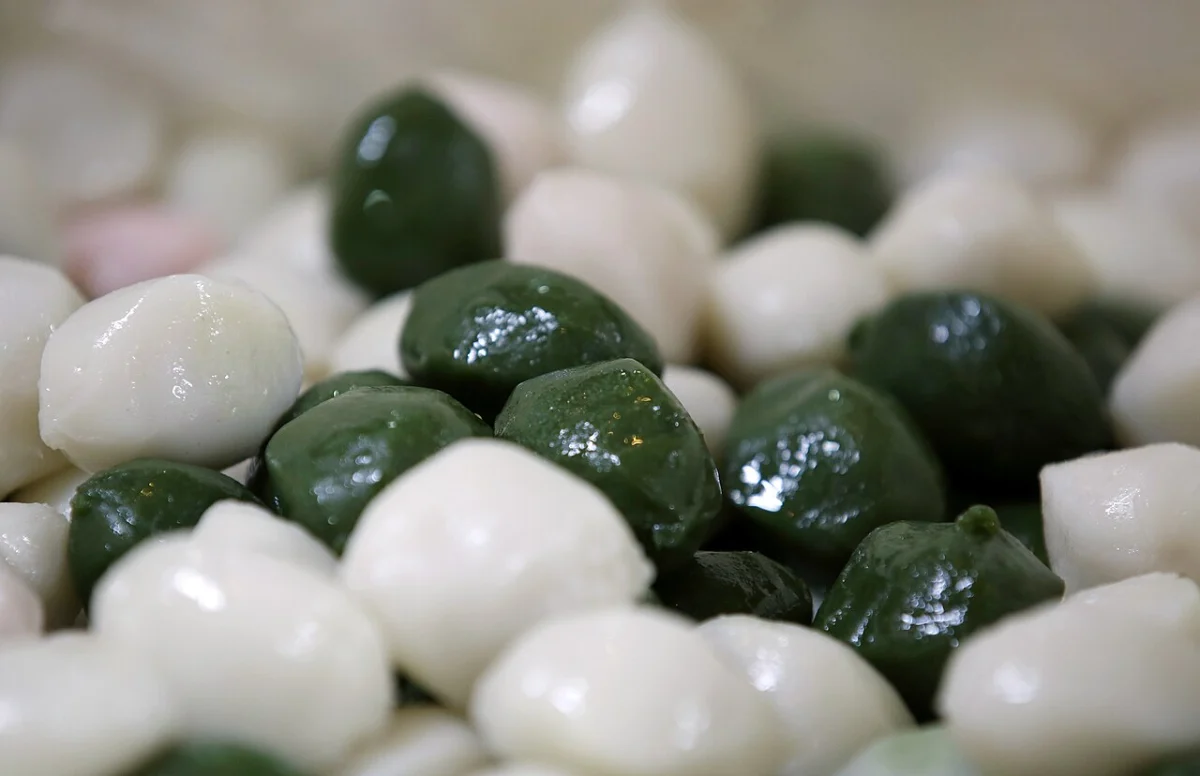

Songpyeon (송편) is the signature Chuseok food. These are small rice cakes shaped like a half-moon, filled with ingredients such as sesame seeds, soybeans, or red beans, and traditionally steamed over pine needles, which gives them a light pine scent.
Other common holiday dishes include jeon (meat, vegetables, or seafood coated in egg and pan-fried) and japchae (stir-fried glass noodles). Curious about Korean dishes for an American Thanksgiving meal? Our guide to Korean food to bring to Thanksgiving covers easy store-bought options, including tteok (rice cakes).
Traditional games and dances
Chuseok also has a long list of traditional folk games and performances. One of the best known is ganggangsullae, a circle dance in which people hold hands and sing under the full moon, traditionally performed by women in Korea’s southwestern coastal region. Today ganggangsullae is preserved and performed as a folk art, and during the holiday visitors can often see it, or ssireum (Korean wrestling), at festivals, museums, and folk villages.
Chuseok vs. Thanksgiving at a glance
| Chuseok (South Korea) | Thanksgiving (United States) | |
|---|---|---|
| Date | 15th day of the 8th lunar month; moves each year, usually September or early October | Fourth Thursday of November |
| Time off | Three-day public holiday (the day before, the day of, and the day after) | One federal holiday (Thursday) |
| Roots | Recorded in Korea’s early histories; tied to the harvest and the full moon | Colonial-era harvest observances, including the 1621 Plymouth gathering; made a national holiday by presidential proclamation and federal law |
| Main focus and traditions | Harvest, family, and honoring ancestors through charye and grave visits | Giving thanks and a shared family meal |
| Signature foods | Songpyeon, jeon, dishes made from the new harvest | Turkey, stuffing, pumpkin pie |
| Travel | Mass trip home to hometowns and family | Many people travel to be with family |
How Chuseok is changing
Many Korean families still hold charye, but survey data suggest fewer plan to, and many keep it simpler.
- Fewer households planning the rite. In a Korea Rural Economic Institute web survey of 1,000 household consumers in August 2026, 27.3% said they planned to hold charye for Chuseok, compared with 40.4% the previous year. These are plans reported in one survey, not a count of what all Korean households actually did.
- Simpler tables. Among those who planned to hold the rite, 50.9% chose a simplified version that still follows traditional etiquette.
- A Confucian body recommends simplifying. In 2022, the Ritual Reform Committee of Sungkyunkwan, Korea’s best-known Confucian institution, proposed a simplified “standard” charye table. Its basic list had just six items: songpyeon, seasoned vegetables, grilled meat, kimchi, fruit, and liquor, with more dishes optional. The committee also said a photo of the ancestor can stand in for the traditional paper tablet. At the announcement, an official of Sungkyunkwan’s Confucian association added that popular placement rules, such as hongdong baekseo (red fruit to the east, white to the west), aren’t found in any ritual text. This is a recommendation, not a rule every family follows.
So you’ll find a wide range in Korea today: families who keep the full rite, families who hold a short version, families who only visit the graves, and families who use the long weekend to rest or travel.
The Thanksgiving story is complicated, too
The familiar story of the first American Thanksgiving also leaves out important history. The picture of Pilgrims and Wampanoag people sharing a friendly meal in 1621 is, as the Smithsonian’s National Museum of the American Indian explains, incomplete and inaccurate. The modern national holiday took shape later: George Washington proclaimed a day of thanksgiving in 1789, Abraham Lincoln made it an annual national observance in 1863, and Congress fixed it on the fourth Thursday of November in 1941, according to the National Archives.
If you have Korean friends or coworkers
- A simple greeting works. “Happy Chuseok” is fine in English. In Korean, people often say Jeulgeoun Chuseok bonaeseyo (즐거운 추석 보내세요), “Have a happy Chuseok.”
- Don’t assume everyone does the rites or goes home. Some families hold charye and some don’t.
- Expect it to fall at different times. Because the date follows the lunar calendar, a Korean colleague’s Chuseok plans may land anywhere from early September to early October.
- Korean American families vary. How, or whether, a family marks Chuseok in the US differs from home to home, so ask rather than assume.
Frequently asked questions
Is Chuseok the same as the Mid-Autumn Festival? It falls on the same lunar date as the Mid-Autumn Festival celebrated in China and elsewhere, and one of Chuseok’s Korean names means “mid-autumn festival.” But Chuseok has its own Korean customs, such as charye, grave visits, and songpyeon.
Is Chuseok a holiday in the United States? No, it’s not a federal holiday, although individual families and communities may mark it on their own.
Do Koreans celebrate American Thanksgiving? It’s not a public holiday in South Korea. Chuseok is the country’s big fall family holiday.
When is Chuseok in 2027? Wednesday, September 15, 2027, with public holidays from September 14 to 16, according to the Korea AeroSpace Administration’s official 2027 calendar.
Sources
- VisitKorea (Korea Tourism Organization): 2026 Chuseok Holiday Travel Guide (checked November 6, 2026)
- Encyclopedia of Korean Culture (Academy of Korean Studies): 추석 Chuseok (Korean, last revised Aug. 27, 2026) (checked November 6, 2026)
- National Folk Museum of Korea: What is Charye? (checked November 6, 2026)
- Korea Rural Economic Institute: 2026 Chuseok fruit purchasing survey and supply outlook, PRN239 (Korean, Sept. 16, 2026) (checked November 6, 2026)
- Seoul Shinmun: Sungkyunkwan unveils a simplified charye table (Korean, Sept. 5, 2022) (checked November 6, 2026)
- Wikitree: 30.75 million trips during the 2026 Chuseok travel period, citing the transport ministry's provisional count (Korean, Sept. 29, 2026) (checked November 6, 2026)
- Korea AeroSpace Administration: 2027 calendar (월력요항) press release (Korean, June 29, 2026, via Korea.kr) (checked November 6, 2026)
- National Archives: Congress Establishes Thanksgiving (checked November 6, 2026)
- Smithsonian National Museum of the American Indian: Rethinking Thanksgiving Celebrations (updated July 5, 2024) (checked November 6, 2026)
Spotted an error? Tell us and we will correct it. See how we write.