Aigoo, Daebak, Hwaiting: What These Korean Expressions Mean and When to Use Them
What aigoo, daebak, and hwaiting mean, how Koreans actually use them, and when each one fits or doesn't, with dictionary definitions and simple examples.
Published
If you watch K-dramas or Korean variety shows, you may hear three expressions again and again: aigoo, daebak, and hwaiting. Subtitles often turn them into “oh my,” “awesome,” and “you can do it,” which is close but not the whole story. Each one has its own range, and each one can land wrong in the wrong moment.
The short version:
| Word | Hangul | Roughly | Good for | Be careful with |
|---|---|---|---|---|
| Aigoo | 아이고 | “oh my,” “ugh,” “oh dear” | being tired, hurt, surprised, or warmly surprised to see someone | it is also the traditional wailing cry of mourning |
| Daebak | 대박 | “a big hit”; casually, “wow” or “awesome” | good news, great food, a surprise among friends | the “wow!” use is casual slang |
| Hwaiting | 화이팅 / 파이팅 | “go!”, “you can do it!” | cheering on a team, a friend before an exam or interview | it comes from English “fighting” but means encouragement, not a fight |
Spellings
You’ll see these words spelled several ways. Under South Korea’s official romanization they are aigo, daebak, and paiting. Subtitles and fans usually write aigoo (or aigo, aigu), daebak, and hwaiting (or fighting). This guide uses aigoo and hwaiting because those are familiar spellings among many English-speaking fans.
Aigoo (아이고): one word, many feelings
Aigoo is an exclamation whose meaning depends on tone and context. South Korea’s Standard Korean Language Dictionary, published by the National Institute of Korean Language, gives it four senses (the translations are ours):
- A sound you make when you’re in pain, worn out, startled, aggrieved, or dumbfounded. The dictionary’s examples: “Aigoo, my stomach,” and “Aigoo, let’s rest a little before we go.”
- A sound you make when you’re glad or delighted, as in “Aigoo, how long has it been?” when you run into someone.
- A sound of despair, frustration, or lament: “Aigoo, there’s nothing more I can do.”
- The sound of crying, especially the wailing of mourners during a funeral period.
So aigoo covers a lot of ground. In a K-drama, a grandmother who sits down with a groan, a mother who spots her son at the door, and a character who drops a tray of food might all say it, each meaning something different. Tone and context tell you which.
The dictionary also points to close relatives: eoigu (어이구) and aiko (아이코). You’ll hear these in the same kinds of moments.
When to be careful: the fourth sense is the cry of mourning, so in a funeral setting aigoo can be a sincere expression of grief. What doesn’t fit is saying it playfully, or imitating it as a joke, when someone is grieving. In everyday situations, like a heavy box, a long day, or a spilled drink, it’s simply a natural reaction: Aigoo, himdeureo! (아이고, 힘들어!), “Ugh, I’m exhausted!”
Daebak (대박): from “big hit” to “wow”
In the Standard Korean Language Dictionary, daebak is a noun: a figurative way of saying that something turned out to be a big success. The dictionary’s examples are daebagi nada (대박이 나다) and daebagi teojida (대박이 터지다), both roughly “to hit it big,” and daebageul teotteurida (대박을 터뜨리다), “to make a big hit.”
In casual speech it’s also a common reaction of surprise, amazement, or approval, said on its own: Wa, daebak! (와, 대박!), “Wow, that’s amazing!” English has picked this up too. In its September 2021 update, the Oxford English Dictionary added daebak among 26 words of Korean origin, and the Korea JoongAng Daily noted that the OED treats it as an adjective as well, as in “This show is daebak!”, even though Korean dictionaries list it only as a noun.
When to be careful: the exclamation is slang. It’s often fine in casual conversation with friends and classmates. In formal writing or with someone you’d normally speak to formally, like a new boss or an older stranger, a plainer reaction fits better.
Hwaiting (화이팅 / 파이팅): a cheer, not a fight
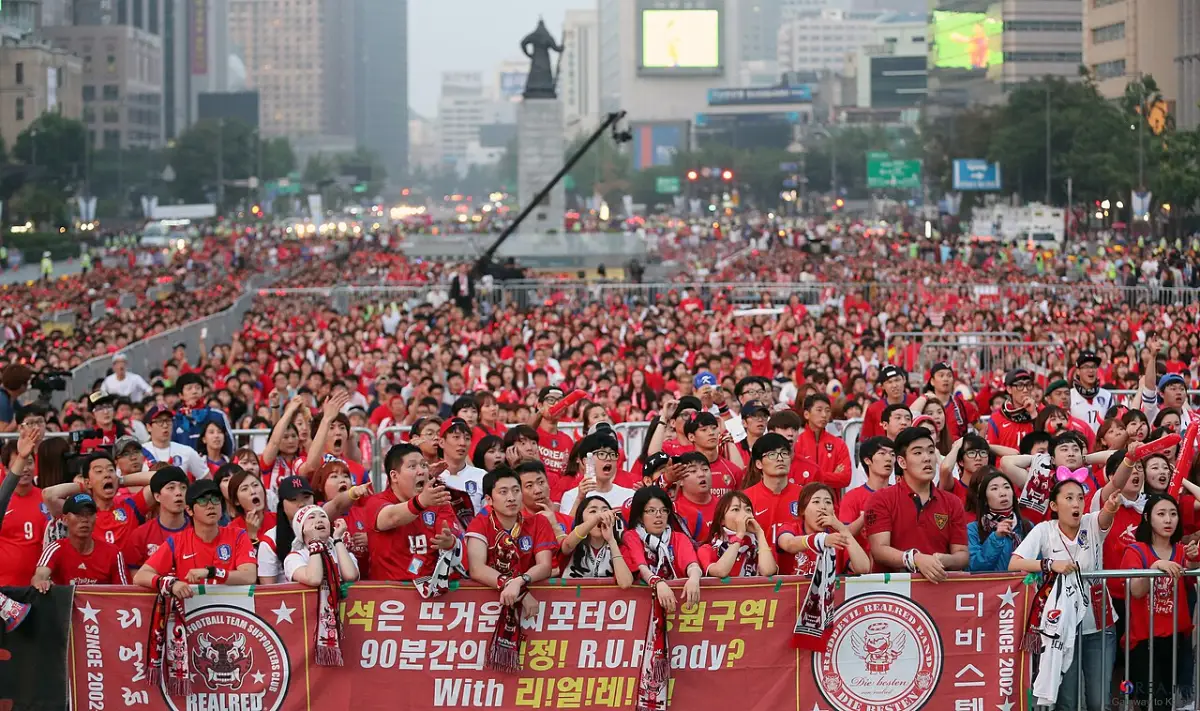
Hwaiting comes from the English word “fighting,” but in Korean it means encouragement. The Standard Korean Language Dictionary lists it, spelled paiting (파이팅), as an interjection: the cry teammates shout to urge each other on in a sports match, or that supporters shout to tell players to do their best. Its example is Uri tim, paiting! (우리 팀, 파이팅!), “Go, our team!”
Outside sports, people also use it to encourage friends, classmates, and coworkers before a challenge, like a job interview, a big presentation, or an exam: Siheom paiting! (시험 파이팅!), roughly “Good luck on your exam, you’ve got this!”

A few more things worth knowing:
- Two spellings in Korean. The dictionary spelling is 파이팅 (paiting). You’ll often see 화이팅 (hwaiting) on signs and screens, but that form isn’t the standard spelling and has no entry of its own in the Standard Korean Language Dictionary.
- There’s an official Korean alternative. In 2004, the National Institute of Korean Language chose aja (아자) as a native-Korean replacement for paiting. Its own yearbook noted criticism of the choice, and 파이팅 remains the dictionary headword. NPR describes “fighting” as often heard in K-dramas and variety shows.
- English knows it too. The OED’s 2021 update added fighting as an interjection used to express encouragement and support, according to NPR.
When to be careful: to an English speaker who doesn’t know the Korean usage, “Fighting!” can sound aggressive. If you use it with people outside K-culture, a quick “it’s a Korean way of saying ‘you’ve got this’” helps.
Using them yourself
You don’t need to speak Korean to use these words with Korean friends. A few pointers:
- Match the setting. These expressions often appear in casual speech, though what fits depends on the context. In general they suit chats, texts, and friendly conversation better than work email.
- Let tone do the work with aigoo. A tired groan and a bright, surprised “aigoo!” when you see an old friend mean different things.
- Treat hwaiting as a cheer, not a verb. A common pattern is to put it after the thing someone is facing, as in siheom paiting (“exam, hwaiting!”).
If you’re curious about other words you keep hearing on screen, our guide to oppa, unnie, hyung, and noona explains who can use those terms and why.
Frequently asked questions
Is it “hwaiting” or “fighting”? Both are used. They’re the same expression borrowed from English “fighting.” The standard Korean spelling is 파이팅 (paiting), while 화이팅 (hwaiting) is a very common nonstandard spelling.
Is “daebak” rude? No, but the “wow!” use is casual slang. Use it with friends, not in formal situations.
Does “aigoo” mean “oh my god”? Sometimes that’s the closest English, but aigoo covers more: pain, tiredness, surprise, frustration, happy surprise, and, in its traditional sense, the cry of mourning. Unlike the English phrase “oh my God,” aigoo isn’t a religious expression.
Sources
- Standard Korean Language Dictionary (National Institute of Korean Language): 아이고 (checked November 6, 2026)
- Standard Korean Language Dictionary: 대박 (checked November 6, 2026)
- Standard Korean Language Dictionary: 파이팅 (checked November 6, 2026)
- National Institute of Korean Language, Korean Language Yearbook 2005: 2004 language refinement, 'aja' chosen for 'paiting' (Korean) (checked November 6, 2026)
- NPR: Oxford English Dictionary rides the K-wave with a big Korean update (Oct. 14, 2021) (checked November 6, 2026)
- Korea JoongAng Daily: Drop your kimbap and call your oppa, the OED has 26 new additions (Dec. 2, 2021) (checked November 6, 2026)
Spotted an error? Tell us and we will correct it. See how we write.